Value for Value ⚡️
Episode Summary
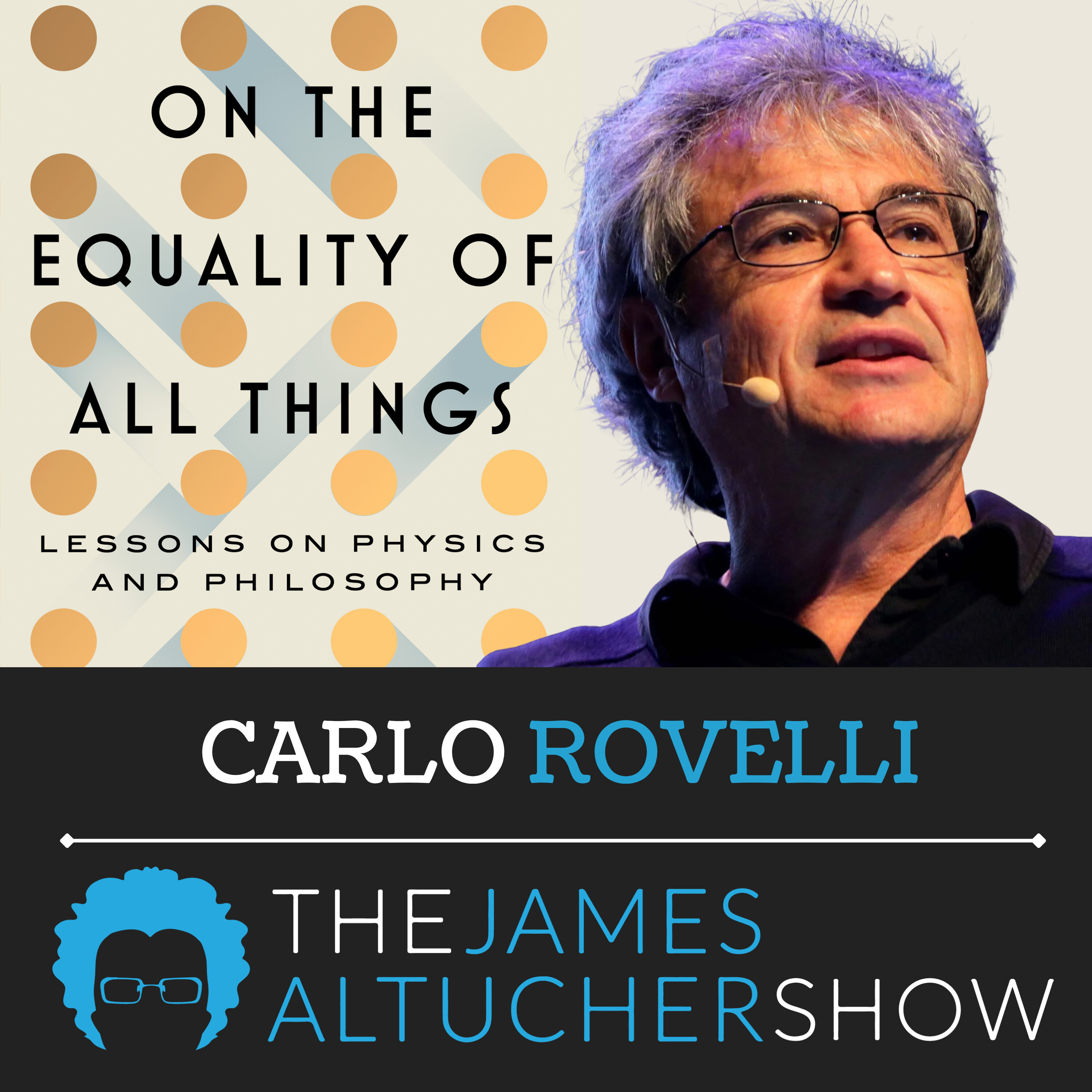
A Note from James:Carlo Rovelli is one of the smartest people I know. He is a theoretical physicist and the author of a lot of great books, including Seven Brief Lessons on Physics, The Order of Time, Helgoland, White Holes, and now On the Equality of All Things: Lessons on Physics and Philosophy.He has been on the show before, and at the end of this conversation I told him I felt like he was just tolerating my questions. He was nice about it.But the first question I asked was: Do I actually exist?Because in Carlo’s new book, nothing really exists on its own. Not a person, not a particle, not you, not me. Everything exists in relation to something else.So I spent an hour trying to understand what that means.Does absolute truth exist? Is free will fake? Are we just machines? Is consciousness quantum? Is everything doomed to decay? Is time real? Was there a before the Big Bang? And what does any of this actually do for us in ordinary life?Carlo’s answer, again and again, is not that nothing is real. It is that we make a mistake when we try to imagine the world from the outside, as if we were standing somewhere beyond the universe looking in. We are not outside the universe. We are inside it. We are part of it. We know the world through relationships, perspectives, interactions, and limits.And oddly, that is calming.Because Carlo says the thing that brought him serenity was not finally knowing everything. It was giving up the need to know everything with absolute certainty.That is where this conversation goes: physics, quantum mechanics, philosophy, Buddhism, Taoism, Wittgenstein, consciousness, black holes, time, the Big Bang, free will, and the strange comfort of not needing the final answer.Episode Description:Carlo Rovelli returns to the show for a conversation about reality, uncertainty, quantum mechanics, time, consciousness, free will, and his new book On the Equality of All Things: Lessons on Physics and Philosophy.James begins with the central idea of the book: everything in the universe can only be understood in relation to something else. Carlo agrees that this is a good short version of the argument, but immediately pushes back against the need for “absolute” truth. Of course James exists. Of course Carlo exists. The question is why we need to add something heavier and more final than that.From there, the conversation becomes an exploration of relational reality. Carlo explains that motion is not an illusion just because it depends on perspective. When James says he is sitting still, that is true with respect to Earth. When someone says Earth is moving, that is true with respect to the sun or the galaxy. The mistake is asking which motion is the “real” one outside all relations.The same frame applies to quantum mechanics. Carlo argues that particles are not little objects with fixed properties sitting there independently of the rest of the world. A particle is what it manifests in interaction. It is a set of relations. This is why quantum mechanics has forced such a profound change in the way physicists think about reality.James keeps pressing the practical question: What do we gain from knowing this?Carlo’s answer is partly scientific and partly philosophical. We gain better questions. We stop asking impossible questions like “Who is really not moving?” or “What is the final foundation of everything?” We become more aware of our own perspective. And we may become more capable of understanding people whose moral, political, or philosophical perspectives differ from ours.The conversation moves through the Big Bang and the possibility of a Big Bounce, with Carlo stressing that science is powerful precisely because it knows its own ignorance. Science is not the final story. It is an ongoing proces